
What Happens in an Online Vocal Coaching Assessment?
What Happens in an Online Vocal Coaching Assessment?
If you’re considering online vocal coaching, you might be wondering what actually happens in the first session.
Is it a lesson? Is it an audition?
And can a vocal coach really assess your voice properly online?
In my studio, once we’ve had a Discovery Call, the next step is an Initial Fit Session. A 90-minute one-to-one online vocal coaching assessment designed to help us understand your voice before building a training plan.
We’ll look at your vocal health history, current singing habits, technical challenges, movement patterns, goals and the way your voice responds in real time. You’ll bring a song of your choosing, we’ll explore what is happening, and afterwards you’ll receive a personalised written report with next-step recommendations.
You’ll also have the option to receive a video recording of the session, so you can revisit the things we did in your own time.
The aim is not to judge your voice, but to begin to understand it.
How is it different from a trial singing lesson?
A trial lesson gives you a taste of how a teacher works.
An Initial Fit Session goes much deeper.
Instead of jumping straight into generic warm-ups, scales or quick fixes, we take time to look at what might be contributing to the challenges you’re experiencing, how your voice responds, and what kind of training would be most useful for you.
The point is not to prove that you can sing. Instead, we will take a deep dive into your voice, so we can understand it from the very beginning.
Going into detail at the beginning gives us direction. It means we are not spending the first few sessions guessing, trying generic exercises, or working around symptoms without understanding them. By gathering useful information early, we can make ongoing coaching more focused, more efficient and more relevant to your actual voice.
Why I don’t start with generic exercises
Many singers come to online vocal coaching because their voice isn’t feeling quite right.
Maybe it cracks or flips unexpectedly. Maybe your high notes feel tight. Maybe your lower range feels weak. Maybe your voice gets tired quickly, or you feel as though you can sing well one day and then completely lose it the next.
The tricky thing is that the same symptom can have several possible causes.
For example, difficulty with high notes could be caused by breath management, vocal fold closure, registration, tongue tension, jaw tension, mindset, fatigue, vowel choice, or many other things.
That is why I don’t start by handing everyone the same set of exercises and expecting the same results. To make lasting changes to your singing, we need to truly understand what works for you.
Read my blog “Why Does My Voice Hurt When I sing”
How to prepare for your online vocal coaching assessment
When you book your Initial Fit session, you will receive email guidance that will help you get the most out of it.
This includes:
How to select a song to work on
A laptop or computer for Zoom
A second device for backing tracks (a phone or ipad is fine)
Backing tracks ready on YouTube or Spotify
Lyrics somewhere you can see them if you need them
Enough space to stand and sing
Your head and upper torso visible on camera
Original Sound enabled in Zoom audio settings
Headphones, if you like to use them
You do not need to prepare a perfect performance. In fact, the session is more useful when we can see what your voice naturally does.
Can an online vocal coaching assessment really work?
Yes — and I have designed my studio specifically to make it as effective as possible.
You do not need professional audio equipment at your end. A stable internet connection and a reliable device are plenty.
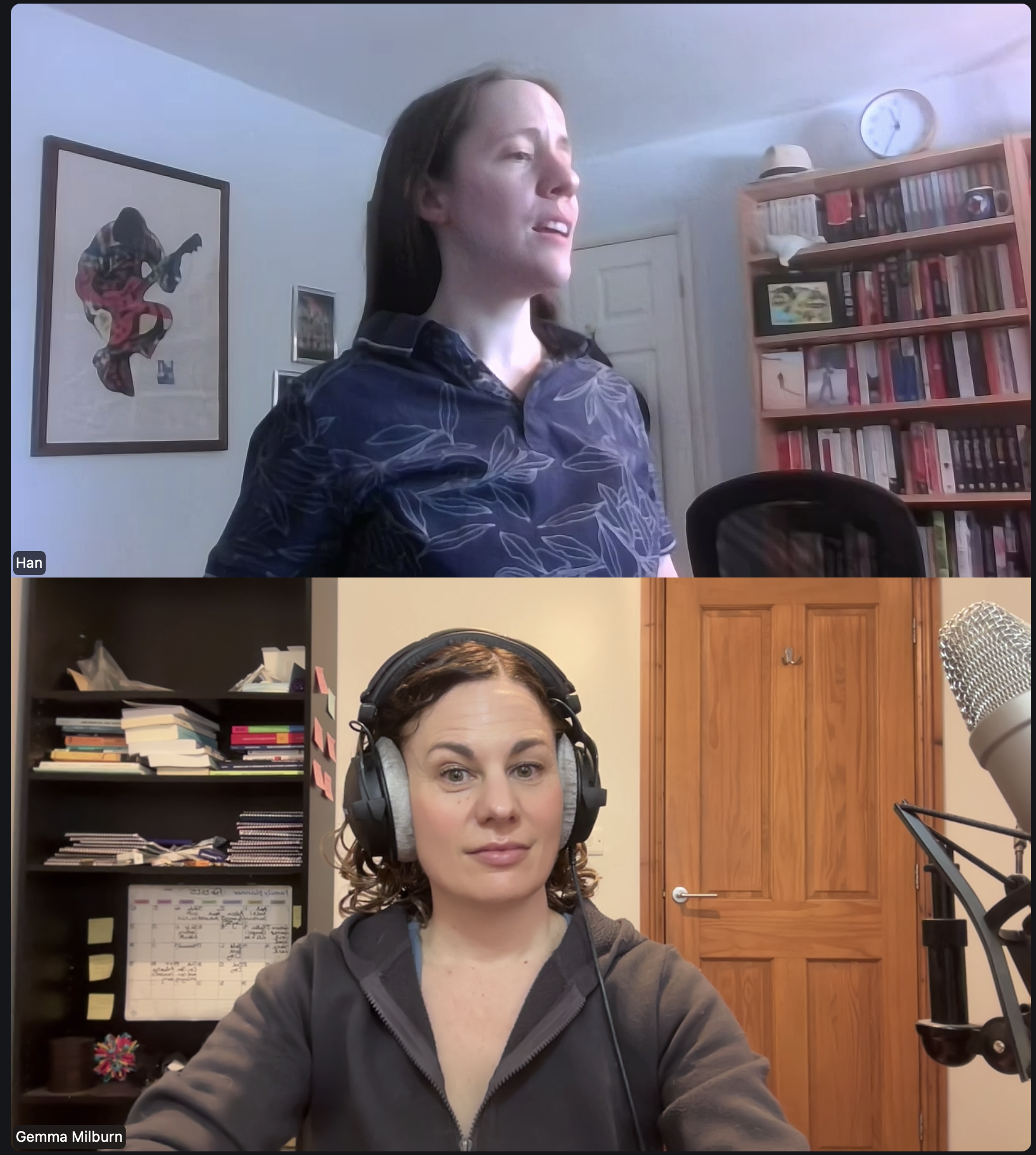
On my end, I use a dedicated online vocal coaching setup, including a MacBook, Focusrite Scarlett 2i2 audio interface, Rode NT1-A microphone and Beyerdynamic DT-770 Pro studio headphones. This helps me hear more detail than I would through standard laptop audio.
Step 1: We start with a vocal health check
The vocal health check is not just admin.
It gives us important context before we start working technically.
Your voice is part of your body, and it is affected by more than just “technique”. Things like vocal load, sleep, hydration, reflux, allergies, medication, hormones, anxiety, coughing, jaw tension, tongue tension and how much you use your voice day to day can all influence how your voice feels and functions. Vocal health gives us valuable clues and training is much more effective when we understand the bigger picture.
I do not diagnose medical voice conditions. If anything suggests you may need medical input, I will refer you on to someone who is qualified to help.
Step 2: We explore your song and how your voice responds
A song gives us real-world information.
Scales and exercises can be useful, but songs show how your voice behaves when pitch, words, rhythm, emotion, range and style are all happening at once.
You are invited to bring along a backing track and lyrics for a song that you love, something you are working on, or something that highlights the issue you want help with.
It does not need to be impressive or perfect. In fact, its better to bring something that shows me where you get stuck.
I will lead you through an easy assessment that gives us information about your voice. What makes it feel easier? What increases effort?
What helps the sound become clearer, or more expressive?
What gives us useful information about where to begin?
Sometimes a singer will arrive feeling as though their voice is simply “bad”, “weak” or “unreliable”. But when we explore the voice in this way, we often find that it responds quickly when given different conditions.
That gives us a starting point.
Step 3: We identify what helps
Although the Initial Fit Session is an assessment, you will usually leave with practical insights you can use straight away.
We might discover that your voice responds well to:
A particular body movement
A tongue or jaw adjustment
A change in vowel
A different key
A breath strategy
A different way of approaching a phrase
A warm-up or cool-down idea
A vocal health habit
A more realistic practice structure
The goal is not to fix everything in one session — that would be unrealistic. The goal is to identify what your voice responds to, what needs more attention, and where your training should begin.
This is why the Initial Fit Session gives us such a useful foundation. Instead of guessing, we are working towards your goals from the beginning.
Step 4: You receive a personalised written report
After the session, you will receive a personalised written report.
This summarises what we explored, the things that helped, any relevant vocal health considerations, and my recommendations for next steps.
You’ll also have the option to receive a video recording of the session, so you can watch back the exercises, observations and feedback in your own time. This can be especially useful when you are practising, because you do not have to rely on memory alone.
Who is an Initial Fit Session for?
An Initial Fit Session may be useful if:
Your voice feels tense, weak, tired or unreliable
Your high notes feel inconsistent
Your voice breaks or flips unexpectedly
You struggle with vocal fatigue
You are returning to singing after time away
You feel stuck despite practising
You want to understand your voice better
You are looking for online vocal coaching but do not know where to start
You want a clearer plan rather than random exercises
You are serious about building a voice you can trust
You do not need to be an advanced singer to benefit from an assessment. You might be a beginner, a returning singer, an experienced performer, or someone whose voice has changed over time.
If you’re new to my work, you can read more about my approach to online vocal coaching here.
What happens after the Initial Fit Session?
After your Initial Fit Session, I’ll make recommendations based on what we found.
Because we have already taken time to look at your voice in detail, we can move into ongoing coaching with a clearer sense of direction. For some singers, occasional drop-in sessions may be enough, especially if they have a specific short-term goal or already have a strong technical foundation.
For others, regular online vocal coaching is more appropriate. Lasting vocal change usually needs continuity, repetition and time for new patterns to settle into the voice.
If ongoing coaching feels like the right next step, I’ll suggest the most suitable option for your goals, voice and schedule.
The aim is to give you the kind of support that would genuinely help you to get where you want to be with your singing.
Final thoughts
Your voice is unique, so your training should be too.
An online vocal coaching assessment gives us the chance to slow down, look at what is really happening, and build your training from there.
Instead of starting with generic exercises, we start with your actual voice: how it feels, how it responds, what it needs, and where you want to go next.
That deeper first session gives us direction and saves time going forwards. It helps us avoid guesswork and gives your ongoing vocal coaching a clearer foundation from the beginning.
If you are looking for online vocal coaching that is structured, personalised and rooted in vocal health, the Initial Fit Session is the best place to begin.
Ready to take the first step?
Looking for online vocal coaching that is actually tailored to your voice?
The first step is to book a free Discovery Call. We’ll talk about what’s going on with your voice, what you’re hoping to achieve, and whether an Initial Fit Session is the right next step for you.
From there, we can take a proper look at what’s happening, what helps, and how to build training that fits you.