
Tongue Tie and Singing: A Clear Support Pathway for Singers
Tongue Tie and Singing: A Clear Support Pathway for Singers
If you’re a singer wondering whether being tongue tied might be affecting your voice, it can be surprisingly difficult to know where to start.
You might have read articles, watched videos, joined Facebook groups, spoken to other singers, or started noticing things in your own body that suddenly seem connected. Perhaps you’ve been told being tongue tied will not affect your singing. Perhaps you’ve been told it explains everything. Neither extreme is usually very helpful.
I understand this deeply, because I have been there.
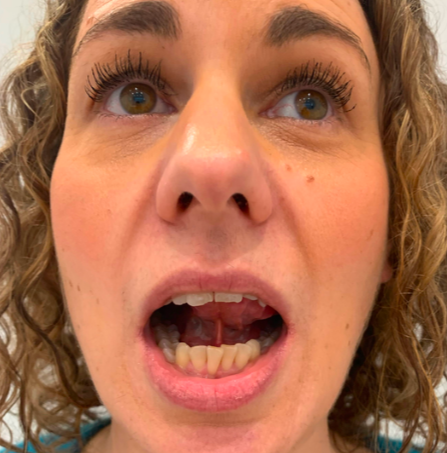
I am a vocal coach and singer who found out I was tongue tied in my late 30s. I had always struggled with my singing and always felt something was missing. Learning I was tongue tied, and then figuring out what the hell to do about it, completely changed the way I sing and coach singers.
I have used what I learned along the way to design a tongue tie support pathway for singers, so they can have a clearer, calmer way forward.
There are two main ways I support singers who are tongue tied:
What is a Tongue Tie Clarity Session?
A Tongue Tie & Voice Clarity Session is a one-off online session for singers who are tongue tied, or suspect they may be. It is a space to talk through your concerns, experiences, and questions about being tongue tied and how it relates to singing.
It is not a diagnosis or treatment - I am not qualified to offer those.
However, I can signpost you to trusted practitioners who can help with assessment, diagnosis, treatment, and myofunctional therapy.
Many singers arrive at this point in their journey feeling overwhelmed and in a rush to make a decision about their next move. As a singer, however, you cannot afford to make a hasty decision here.
The Clarity Session is designed to help you slow down, organise your thoughts, and make informed decisions about what comes next.
What happens in the session?
During a Tongue Tie & Voice Clarity Session, we may talk about:
What has led you to wonder whether you are tongue tied
What you notice when you sing
Any patterns around tension, fatigue, breath, range, articulation, or vocal reliability
What you have already explored
What questions you still have
What might be useful to research next
How singing might fit into the bigger picture
For some singers, discovering they are tongue tied can bring relief. For others, it can bring uncertainty, frustration, grief, or self-doubt. Sometimes it raises big questions about your voice, your training history, and why singing has felt difficult for so long.
The aim of the Clarity Session is not to tell you what to do. It is to help you feel better informed, less alone, and clearer about your possible next steps.
What the Tongue Tie & Voice Clarity Session is NOT
The Clarity Session is not:
A tongue tie assessment
A diagnosis
Medical advice
A recommendation to have (or not have) a release
A treatment plan
Myofunctional therapy
Rehabilitation after a release
Instead, it is a space to explore your experiences as a singer, understand the questions you need to ask, and make more informed decisions about what comes next.
What is Tongue Tie-Aware Vocal Coaching?
I also offer ongoing support for singers who are/have been affected by a tongue tie.
Tongue tie-aware vocal coaching is for singers who:
Are tongue tied and not currently pursuing treatment
Are exploring possible treatment
Are already in myofunctional therapy
Are preparing for a release
Have had a release and want support with their singing afterwards
This is different from a Clarity Session because we are actively working with your voice.
In vocal coaching, we look at how your whole vocal system is functioning when you sing. That may include breath, tongue movement, jaw freedom, resonance, vocal effort, body awareness, registration, confidence, and creativity.
We use knowledge of how being tongue tied can affect the body to help you move forwards with your singing. It is not about forcing your tongue to behave or trying to "fix" you. It is about helping you understand your voice through this additional lens and finding ways to sing with more freedom, reliability, and choice.
How Tongue Tie Aware vocal coaching can support singers before, during, and after treatment
No Planned Release
If you are still tongue tied and not planning on having treatment, this is absolutely OK.
I work with several tongue tied singers who have no desire for a release.
Tongue tie-aware vocal coaching can help you work with the voice and body you currently have. We work within your existing range of motion, aiming to bring efficiency and ease into your singing while embracing the things that make your voice unique. At the same time, we ensure you know how to keep your voice healthy and resilient.
In the Process
If you are going through myofunctional therapy or preparing for a release, tongue tie-aware vocal coaching can be a valuable addition to the process.
Your tongue, jaw, breathing, and body may be making significant adaptations during this time. We work with those changes rather than against them, helping you integrate your singing into the wider process.
Where appropriate, I can liaise with your support team to ensure we are all working towards the same goals.
Post Release
If you have been through myofunctional therapy and a tongue tie release, tongue tie-aware vocal coaching can be a fantastic way to discover your new voice.
Whilst many singers notice immediate changes following their procedure, the body still needs time to adapt. You may still be using compensatory habits that developed over many years and need support to move beyond them.
This is where vocal coaching can be particularly valuable, helping you integrate those changes into your singing in a sustainable way.
What makes my approach different?
Many tongue tied singers have had their concerns dismissed.
They may have been told that tongue ties only affect babies, that they do not affect singing, or that their difficulties are "just tension" or "just anxiety".
My own experience, and my work with singers, has shown me that being tongue tied can affect singing in ways that deserve careful consideration.
That does not mean assuming that being tongue tied is the cause of everything. It means being open, curious, and informed enough to explore the possibility properly.
My approach brings together three dimensions.
The Physical Dimension
I understand how tongue restriction, jaw tension, breathing patterns, body alignment, and vocal habits can interact in singing.
As a vocal coach, Vocal Habilitation Professional, and Buteyko Breathing Instructor, I look at the voice as part of a whole system rather than as an isolated instrument.
The Emotional Dimension
I also understand how confusing and emotional this subject can be.
If singing has always felt harder than you think it should, discovering that you are tongue tied can be a lot to take in. It can affect your confidence, your identity as a singer, and the way you understand your past experiences with your voice.
Having a coach who understands this both professionally and personally can make a big difference.
The Practical Dimension
I understand the treatment journey and how important it is for singers to make informed decisions.
I cannot diagnose or treat your tongue tie, but I can help you advocate for yourself, ask better questions, make sense of your experience, and support your singing before, during, or after the process.
Which option is right for you?
If you want to talk through your questions and work out what to research next, the Tongue Tie & Voice Clarity Session is the best place to start.
If you already know you want support with your singing, and you want ongoing voice work with someone who understands what it means to be tongue tied, then tongue tie-aware vocal coaching may be the better fit.
For Tongue Tie aware Vocal Coaching, a Discovery Call is the best place to start.